Hard Water Stain Removal in San Juan Capistrano
Before the Inland Heat Bakes Them On
Hard water stain removal in San Juan Capistrano for glass spotted by sprinklers and pool splash. Every pane is assessed first, and treatment runs $150 to $350.
Where hard water spots in San Juan Capistrano come from
Look at the window that faces your lawn or your pool. If it carries a haze of white dots that a wet rag won't move, that's mineral scale, and it almost always traces back to water drying on the glass. Sprinklers are the number one cause. Overspray lands on the pane, the water evaporates, and calcium deposits and silica stay behind. Pool splash, a misaimed drip line and a hose left to air-dry all do the same thing.
San Juan Capistrano makes this worse in two ways. The tap water is hard, and the city is hot. Sitting about 3 miles inland, SJC gets more summer sun and less marine layer than the coast, so a wet window dries in minutes instead of hours. Fast drying leaves tighter, denser rings, and every sprinkler cycle adds another layer in the same place. Pollen and dust carried in on Santa Ana winds then cling to that rough film, which is why the stained panes also look dirtiest after a fall wind.
Salt isn't the main problem here. Coastal glass within about 2 miles of the surf collects salt film quickly, but in SJC the stains on your windows are mostly from your own irrigation and pool water. That's good news for hard water stain removal in San Juan Capistrano, because the source is usually something you can change.
How hard is San Juan Capistrano tap water?
Hard, and it changes through the year. Santa Margarita Water District's 2026 water quality report for its San Juan Capistrano system, which covers 2025 data, lists an average total hardness of 210 mg/L, or 12 grains per gallon. The range in that report runs from 89 to 290 mg/L, which is 5.2 to 17 gpg.
For scale, the USGS classes water above 180 mg/L (10.5 gpg) as very hard. SJC's average clears that line, and its top reading is well past it. The same SMWD report gives average total dissolved solids of 503 ppm, with a range of 260 to 680 ppm, and sodium at 84 ppm.
Why the number swings
SJC's supply is a blend. One part is local groundwater pumped from 8 wells in the San Juan Basin and treated at the San Juan Groundwater Recovery Plant with sand separators, green sand filters, cartridge filters and reverse osmosis. SMWD reports that this treated water leaves the plant at about 0.17 gpg hardness and 93 ppm TDS. The other part is imported water from the Metropolitan Water District, a mix of Colorado River and State Water Project supply, plus water from Irvine Ranch Water District.
When the blend leans on groundwater, your tap runs softer. When imported water makes up more of it, hardness climbs toward 17 gpg. That's why some homeowners notice spots forming faster in certain months even though the sprinkler schedule hasn't changed.
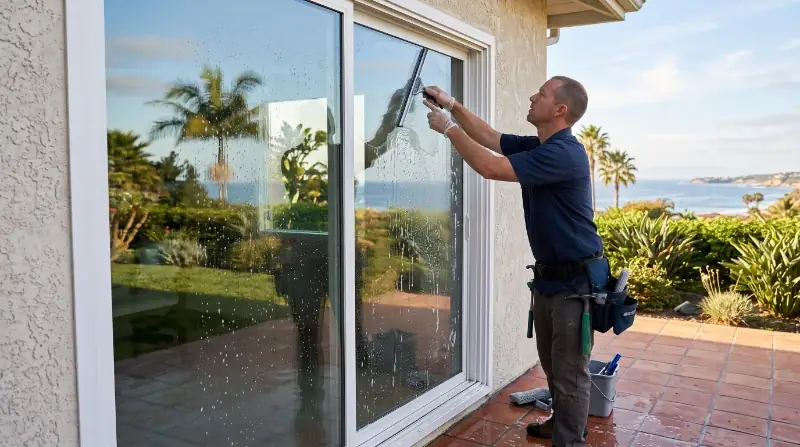
Mineral deposits on windows: what is actually on your glass
Hard water stains aren't one thing. Calcium carbonate makes up the chalky white rings, and it dissolves in mild acid such as vinegar when it's fresh. Silica is the harder problem. Vinegar won't touch it, and it bonds to the surface of the glass as it dries.
The stages of hard water damage
- Fresh spotting. Light dots and rings from the last few weeks. A pure water wash usually takes these off.
- Built-up scale. Months of layered deposits that feel rough under a fingertip. This needs a mineral-dissolving treatment.
- Etching. Spots left 6 months or more can etch the glass itself. The surface is pitted, and the cloudiness stays even when the glass is wet.
A simple test: wet the spotted area. If the haze nearly vanishes while wet and returns when dry, it's mostly surface deposit and can usually be removed. If it looks the same wet or dry, etching is likely.
Can hard water stains be removed from glass for good?
The deposits can, as long as the glass isn't etched. A mineral-dissolving treatment lifts bonded scale, and the window looks new once it's rinsed. On a pool-facing slider the before and after is often night and day, and the family room behind it gets its natural light back. But if the sprinkler keeps hitting that pane, new spots start forming with the next watering cycle.
Etched glass is different. Once minerals have pitted the surface, treatment can soften the look but can't rebuild the glass, and in severe cases the honest answer is replacement. We tell you which panes are which during the assessment, before you approve anything.
How we remove mineral deposits on windows without scratching
Every visit includes a hard water check. When we find bonded deposits, this is how the treatment goes:
- Assessment. We look at each affected pane, do the wet-dry check and tell you which ones can be restored and which show etching.
- Quote first. You get the treatment price, typically $150 to $350 added to the wash, and approve it before we start.
- Treatment. A mineral-dissolving product is applied to the stained glass and left to work for a controlled time, then agitated with a soft pad. No razor scraping on spotted glass. The product goes only on the stained panes; the rest of the house gets a plain pure water wash with no harsh chemicals.
- Pure water rinse. The glass is rinsed with deionized, 0-TDS water so no fresh minerals dry back onto the clean surface and it dries streak-free. Upper-story panes get this rinse from the ground through a water-fed pole.
- Check and walkthrough. We review the treated panes with you in daylight.
That last rinse is what keeps the result clean. Rinsing treated glass with tap water at 12 gpg would just start the next layer. Our explainer on how deionized water cleaning works covers why pure water dries spot-free, and the Orange County hard water damage guide compares SJC with nearby districts.
What to expect after treatment
Treated glass should look even across the whole pane, without the blotchy patches that partial removal leaves. Panes we flagged as etched may still show a faint cloud in low sun, and we'll have pointed those out during the assessment. If spots do return, the first ones to show up tell you exactly which sprinkler or pool area to fix.
How much does hard water stain removal cost in San Juan Capistrano?
Clarity Coast charges $150 to $350 for hard water stain removal, added to a regular window washing visit. Where your job lands in that range depends on how many panes are stained and how far the scale has built up. We always assess it before work begins, so the figure is set before you agree to it. The work is done by vetted local pros, and Clarity Coast is licensed and insured in California.
Hard water stain removal in San Juan Capistrano tends to cost more on estates with long runs of pool-facing sliders than on ranch homes, simply because there is more stained glass to treat. If you're getting ready to sell, start with the street-facing panes, since buyers judge curb appeal long before they see the backyard.
The base wash covers glass inside and out, with screens, tracks and sills included, and follows the same price bands as the rest of our service area, with no travel fee to SJC. The San Juan Capistrano window washing cost page has the full breakdown by home type.
Keeping hard water spots off your SJC windows
Once the glass is clean, prevention is mostly about stopping water from drying on it.
- Turn or swap the sprinkler heads. A head that throws onto a window is the fastest way to undo a treatment. Lower-arc nozzles or drip lines near the house help a lot.
- Water early. Running sprinklers before sunrise gives overspray a better chance to drip off before the sun heats the glass. Midday cycles on sun-facing walls are the worst case.
- Watch pool splash. Sliders right next to the pool catch spray from swimmers and cleaners. A quick squeegee after a swim day saves a lot of scale.
- Don't hose and walk away. If you rinse dust off yourself, dry the glass with a squeegee instead of letting it air-dry.
- Check again when the blend shifts. Because SJC hardness swings between 5.2 and 17 gpg in SMWD's report, a pane that stayed clean in spring can spot quickly later in the year. A monthly glance at the sprinkler-side windows catches it early.
- Keep a quarterly cycle. Regular pure water washes remove fresh spots before they bond, which is why we suggest about every 3 months for inland homes.
Wondering whether a softener would help? Our post on hard water vs soft water on windows walks through what each does to glass. For the wider picture of dust, trails and schedules around town, see the San Juan Capistrano window washing hub, or start at the Clarity Coast homepage.
More Questions About Hard Water Stain Removal
Will vinegar take hard water spots off my windows?
It can lift fresh calcium spots, but it won't dissolve silica, and it does nothing for etched glass. If vinegar leaves a faint haze behind after a couple of tries, the remaining deposit likely needs professional treatment.
Do I need hard water stain removal on every window?
Usually not. In SJC the damage tends to cluster on panes facing sprinklers or the pool. We assess each window and only quote treatment where it's needed.
Can you remove hard water spots from shower glass too?
Our service is window and door glass. Tell us about any other glass when you call and we'll say honestly whether it fits the job.
Why did spots appear so quickly after I moved in?
Inland heat dries sprinkler spray fast, and SMWD's San Juan Capistrano water averages 12 grains per gallon according to its 2026 report. New owners often inherit sprinkler heads aimed at the house. Checking the spray pattern is a good first step.
How long does a hard water treatment take?
It adds time to a standard visit depending on how many panes are stained and how heavy the scale is. We give you a time estimate along with the price during the assessment.
Are hard water spots harmful to glass or just ugly?
Both, given time. Fresh spots are cosmetic, but deposits left 6 months or more can etch the surface, and etching is permanent. Treating spots within a season or two keeps the damage cosmetic.
More for San Juan Capistrano Homeowners
Book a Hard Water Assessment in SJC
We'll check each stained pane and price the treatment before any work starts. Call (949) 883-1300, Monday to Saturday, 8am to 6pm.