Talega Hard Water Windows: The Irrigation Problem
Fix the sprinkler before the glass
Talega hard water windows spot fast because sprinkler water from Santa Margarita Water District dries on the glass at about 15 grains per gallon.
Who supplies Talega's water, and how hard is it?
Talega's tap and irrigation water comes from Santa Margarita Water District, not the City of San Clemente, and the City states this in its own 2025 water quality report. SMWD's 2026 report for its main system, covering 2025 data, gives an average hardness of 256 mg/L. That works out to 15 grains per gallon.
That's well past the line for very hard water. Under the USGS hardness scale, the very hard category begins at 180 mg/L (10.5 gpg), and Talega's supply stayed above that mark all year. SMWD reports a low of 210 mg/L and a high of 300 mg/L, which is 12.3 to 17.5 grains.
| Measure (SMWD main system, 2026 report) | Average | Range |
|---|---|---|
| Total hardness, mg/L | 256 | 210–300 |
| Total hardness, grains per gallon | 15 | 12.3–17.5 |
| Total dissolved solids, ppm | 614 | 510–680 |
| Sodium, ppm | 95 | — |
The source explains the number. SMWD's main system runs entirely on imported, treated surface water from the Metropolitan Water District and from IRWD's Baker Water Treatment Plant, which draws on MWD water plus Santiago Reservoir, also known as Irvine Lake. No local groundwater goes into it, so there's no softer source in the blend to pull the average down. If you live in Talega and have been reading the City of San Clemente's report, you've been reading about your neighbors' water.
Quick check: if your water bill says Santa Margarita Water District, the SMWD figures above are what your sprinklers are putting on your glass.
Why do hard water spots in Talega come back so fast?
Hard water spots in Talega return quickly because sprinklers rewet the same panes on a fixed schedule, and every cycle adds another layer of minerals. With SMWD's main supply averaging 614 ppm of dissolved solids, one misaimed head can build a visible film in a handful of cycles. A freshly washed window can't stay clean while the source keeps running.
Here's what happens on the pane, and why Talega hard water on windows is really an irrigation story. Water lands, beads up and evaporates, and calcium deposits and silica stay behind. The next cycle wets that deposit again, dissolves a little of it, adds fresh minerals, and dries once more. Within a few weeks the separate dots merge into a cloudy band, usually across the lower third of the window where the spray reaches.
Sun speeds it up. Glass facing south or west heats through the afternoon, so water that lands on it late in the day, or lingers from an early cycle, dries hard and fast. Faster drying packs the minerals more tightly onto the surface.
How irrigation spots differ from coastal salt film
Salt film near the beach is a light, even haze across the whole pane. Irrigation spotting has a shape: dots or arcs crowded onto the bottom half of the glass, often heavier on the side the spray reaches first. If the haze on your window has a pattern, a sprinkler drew it.
Which windows on a Talega house get hit first?
The lowest panes beside planting beds take the most damage, followed by rear sliders facing a slope or greenbelt. Upstairs glass usually stays clear unless a rotor on a slope throws a high arc. When one does, a pro can rinse that second-story pane from the ground with a water-fed pole instead of setting a ladder in your planting bed. Mapping which sides of your house carry spots is the fastest way to find the head responsible.
- Ground-floor windows behind shrub beds. Spray heads in narrow front beds sit a few feet from the glass, and pop-up heads that lean over time end up aimed straight at it.
- Side-yard windows. Side yards in many Talega tracts are tight. A head meant to water a strip of ground can wet a bedroom or bathroom window on the same pass.
- Rear sliders and picture windows facing slopes. HOA slopes often use rotors with a long throw. When wind pushes that spray sideways or uphill, the big view glass at the back of the house catches it.
- South and west elevations. These faces bake in afternoon sun, so whatever water reaches them dries fastest and leaves the toughest spots.
- Windows beside the driveway. Heads along the driveway strip can wet garage-side windows and leave matching white streaks on the concrete. Front and garage-side glass is what neighbors and buyers see, so spots here cost you curb appeal first.
Walk around the house in daylight with this list and mark every spotted pane. Talega hard water windows almost never spot evenly. The pattern nearly always points to one or two heads rather than the whole system.
HOA sprinklers or yours: who fixes the head?
That depends on who maintains the patch of ground the head sits in. In Talega, common slopes and greenbelts are generally the job of the HOA's grounds contractor, back yards are usually the owner's, and front yards vary by tract. Check your HOA's maintenance map or CC&Rs before you adjust a head on common area.
If the head belongs to the HOA, a vague note about wet windows tends to sit in a queue. A specific request gets handled faster. Send the HOA:
- The exact location of the head, with a photo that shows it and the window together.
- The time that zone runs, which you can learn by watching for a morning or two.
- A photo of the glass while it's still wet from the cycle.
- A clear ask: lower the arc, shorten the radius, or turn the nozzle away from the house.
If the head is yours, the fix is often a few minutes with the small adjustment key that fits the nozzle, or a swap to a shorter-radius nozzle. For beds pressed right against the house, converting that zone to drip removes the spray altogether.
Some HOA slopes in south Orange County run on recycled water instead of drinking water. Ask your HOA which supply feeds the heads near your home. Recycled water carries dissolved minerals as well, so everything here applies either way.
How to stop sprinkler spots on windows
To stop sprinkler spots on windows, keep the water off the glass first and clean the glass second. Redirecting the problem head does more than any product, because it removes the cause. After that, a few habits keep new spots from bonding before the next wash.
- Watch a full cycle. Stand outside while each zone runs and note every head that reaches a window, door or frame.
- Adjust or replace. Turn the arc away from the house, cut the radius, or fit a low-angle nozzle. Trim any shrub that has grown in front of a head and is deflecting spray upward.
- Check again on a breezy day. Wind carries spray farther. A head that clears the glass at dawn can soak it on a gusty afternoon.
- Rethink run times on zones you control. Water that hits glass and dries slowly in morning shade leaves a lighter deposit than water landing on a hot pane. If a zone near the house has to run, early morning is the better slot.
- Wipe fresh hits with distilled water. If a cycle soaks a pane, wipe it with distilled water and a clean microfiber before it dries so the minerals can't set. Skip the garden hose; it carries the same SMWD water that made the spot.
- Book the next wash before spots bond. Fresh spots come off in a normal clean. Spots left for months become a separate, costlier job.
Diluted white vinegar can help with fresh calcium spots, but it has no effect on silica, which irrigation water also leaves on glass. That's why vinegar seems to work for a week and then leaves a haze it can't shift.
When do Talega spots need professional removal?
If spots stay put after you wipe the glass with clean water and a soft cloth, they've bonded and need professional removal. Bonded scale takes a mineral-dissolving treatment, controlled dwell time and a 0-TDS deionized water rinse, so nothing from the tap dries back onto the treated glass. Clarity Coast prices hard water stain removal in San Clemente at $150 to $350, assessed pane by pane before any work starts. Whoever you hire should be licensed and insured, because the treatment works directly on your glass, and Clarity Coast is both in California.
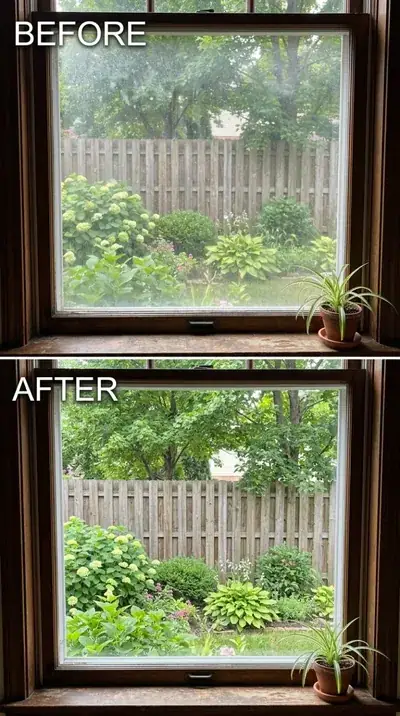
Time decides how far treatment of Talega hard water windows can go. Spots caught within a season usually lift completely. Clearing a season-old cloudy band off a slider facing the greenbelt is a night and day change, and the natural light that was filtering through scale comes back. Spots that have sat on glass for six months or longer can etch the surface, and etching doesn't wash out. At that point treatment can improve the look, but the honest answer may be that a few panes stay faintly marked. You'll hear which group your windows fall into before you approve anything.
For details of the visit itself, including how pros handle HOA homes, screens, tracks and sills on big sliders, and glass inside and out, see our window washing in Talega service page. To understand how spotting moves into scale and then etching across the region, our Orange County hard water damage guide covers every stage.
A year of glass care for a Talega home
Talega spotting follows irrigation and wind more than the calendar, so plan your glass care around the seasons.
- Spring: Irrigation ramps back up after the rainy months. Walk every zone once before the heavy watering season begins. Spring pollen also clings to fresh spray marks, so the spotted panes look dirtier than the rest of the house this time of year.
- Summer: Longest run times and the hottest glass. Misaimed heads do the most damage now, so look over the south and west faces every few weeks.
- Fall: Santa Ana winds arrive mainly from October through December and coat glass in dust. Book a clean within 72 hours of a wind event, before sprinkler water turns that dust into a gritty crust.
- Winter: Rain does part of the watering, so many controllers run less. It's a good time to fix heads and catch up on removal work before spring.
Most inland homes in our service area do well on a quarterly wash, roughly every three months. A pure water wash leaves the glass streak-free and uses no harsh chemicals that could drip onto HOA landscaping. A Talega home with an uncorrected sprinkler problem won't, however often it's cleaned, which is why the head gets fixed first. Standard schedules by neighborhood are on our window washing frequency guide, and you can reach a local pro any time through Clarity Coast window washing in San Clemente.
More Questions About Talega Hard Water
Does the City of San Clemente's water report apply to Talega?
No. The City's 2025 report says Talega is served by Santa Margarita Water District. For Talega, use SMWD's main system report, which shows an average hardness of 15 grains per gallon for 2025.
Will a whole-house water softener stop the spots on my windows?
Not on the outside glass. Sprinklers draw from the irrigation line rather than the softened water inside your house, and softening swaps one mineral for another instead of removing dissolved solids. Moving the spray off the glass does far more.
Can I hose the windows down after the sprinklers run?
That adds another layer instead of removing one. Your hose carries the same SMWD water, averaging 614 ppm of dissolved solids, so it dries into the same spots. If you want to rinse, use distilled water and wipe the glass dry.
Do glass protectant coatings help in Talega?
A water-repellent coating makes droplets bead and roll off faster, which can slow spotting on glass that gets occasional spray. It won't hold up against a head that soaks the same pane every day, and it has to go onto clean, spot-free glass to work. Fix the sprinkler first.
Is spot removal included in a regular window wash?
Light, fresh spotting usually comes off during a standard pure water wash at no extra cost. Bonded hard water stains need a separate treatment, added at $150 to $350 and assessed before work begins, so you know the cost ahead of time.
Keep Reading
- Hard water vs soft water for windowsWhy a softener won't save your glass
- Deionized water window cleaning explainedHow a 0 ppm rinse dries clean
- Window washing in Forster RanchAnother inland HOA neighborhood
- Screen cleaning in San ClementeMineral dust out of the mesh
- Instant quote calculatorPrice your Talega home quickly
Get Your Talega Glass Assessed
Call (949) 883-1300, Monday to Saturday 8am to 6pm. Hard water is checked on every visit and priced before any work starts.