Window Washing in San Clemente
Your Windows Are Getting Destroyed — Here's Why
Window washing in San Clemente is a tougher job than inland: salt film, marine haze, and sprinkler spots build up within days. We use 0-TDS pure water, so glass dries clean.
no minerals left to spot
City 2025 report, very hard
every visit, every home
across all 3 cities
same pricing all week
Why Window Washing in San Clemente Is a Different Job
Salt air off the Pacific films your glass within days. Morning marine layer leaves mineral residue overnight. Santa Ana winds coat everything in dust and ash that gets harder to remove the longer it sits. Window washing in San Clemente is a different job than anywhere else in Orange County, and Clarity Coast built this service around what this coastline does to glass. We use deionized pure water, not tap water, and no harsh chemicals. We remove screens, wash them flat, and reinstall them instead of brushing them in place. And we walk the property with you before we leave.
A few miles inland in Mission Viejo or Lake Forest, dirty windows mostly mean dust and pollen. Here, they mean something else entirely. San Clemente sits where four forces hit glass at once, and each one needs a different response. Get them handled and the difference in natural light through a west-facing living room is night and day.
Salt Air — Year-Round
Within two miles of breaking water at San Clemente Pier, airborne salt runs far heavier than in inland Orange County. Coastal humidity keeps those salt particles from ever fully drying out, so they sit as a damp film on exterior glass. Left alone for many months, salt and mineral deposits can etch the surface, and etching is permanent. At that point the pane needs replacing, not cleaning.
Marine Layer — May Through July
San Clemente's morning marine layer is a temperature inversion: cold ocean air trapped below warmer air, carrying sea spray minerals from the ocean surface. That moisture settles on exterior glass overnight through May, June and into early July. The fog usually burns off by midday, but it leaves a coastal haze on the windows that stays until it is washed off.
Hard Water — Every Irrigation Cycle
The City of San Clemente's 2025 water report lists hardness at 14 gpg for imported Metropolitan Water District supply and 17 gpg from the Baker treatment plant. On the USGS hardness scale, anything above 10.5 gpg counts as very hard. HOA irrigation systems in Talega and Forster Ranch overspray windows on set cycles. The water evaporates, the calcium deposits remain, and every cycle adds a new layer of hard water spots. Vinegar only touches the freshest of them.
Santa Ana Winds — Fall Season
Canyons east of town funnel Santa Ana winds straight toward the coast, and they arrive carrying desert dust and, in fire years, ash. Book a rinse within about 72 hours (2–3 days) after the wind stops, before dew, marine-layer moisture or sprinklers turn that dust into a crust that is harder to remove. This applies to inland Talega just as much as to the bluffs above the pier.
Stack all four on a single pane of glass.
That is what San Clemente coastal glass deals with. Standard methods (spray cleaners, paper towels, vinegar) make it worse, not better.
What You're Looking at on Your Glass
You know something is wrong. Here is what each one usually means and what to do about it.
A haze you cannot wipe off with paper towels
What it is: Salt film or marine layer calcium bonded to the surface. Why paper towels make it worse: Friction from a dry towel on salt-filmed glass leaves micro-scratches, which can turn a temporary haze into a permanent one. A deionized water wash with a soft brush lifts the film without grinding it in.
White spots that come back two weeks after cleaning
What it is: Hard water from your irrigation system. MWD water deposits minerals every watering cycle. The wash removed last season's buildup, and the next irrigation cycle started new spots the same day. Redirecting the sprinkler head that reaches the glass is the only lasting fix, so the pro points out the source as well as cleaning the spots.
A film visible in morning sunlight but gone by noon
What it is: Marine layer condensation residue. Calcium compounds deposited overnight by coastal fog scatter light differently at low sun angles. The deposits are there all day; low morning sun is simply the angle that shows them. A pure water wash takes them off, while wiping with tap water just spreads them around.
Clear from inside, hazy from outside
What it is: Salt and mineral deposits form on the exterior surface only. Salt air and sprinkler water never reach the inside of the pane, so the interior stays clear while the outside collects salt and mineral film from every foggy night since the last professional clean.
A gray coating after a Santa Ana week
What it is: Ash and desert dust. Once the morning marine layer returns, that dry powder gets damp and starts to cake on. Timing: Book a rinse within about 72 hours (2–3 days) after the winds stop, and it usually rinses off. Wait through a few foggy mornings or sprinkler cycles, and it turns into a crust that takes more work to remove.
Permanent cloudiness that won't clean off
What it is: Etching. The glass surface itself has been altered by long-term salt or mineral exposure. Mineral deposits left on glass for many months can etch the surface, and etching is permanent. Replacing a large etched pane usually costs far more than years of regular cleaning, so prevention is the cheaper path by a wide margin.
| What you're seeing | What it means | Act when |
|---|---|---|
| Haze you can't wipe off | Salt film or marine layer calcium bonded to glass | This week |
| White spots from sprinklers | Hard water silica and calcium from sprinklers, bonding tighter each cycle | This week |
| Gray coating after Santa Ana | Dust and ash that cakes on once marine layer moisture returns | Within 72 hours |
| Film only visible in morning sun | Marine layer deposits that build up a little every night | Next service |
| Hazy even after cleaning | Early etching: the glass surface itself is changing, not just dirty | Call today |
| Permanent cloudiness — won't clean | Established etching that cannot be reversed; the pane needs replacing | Assessment now |
How Often Should You Get Your Windows Washed in San Clemente?
The right answer depends on where in San Clemente your home sits. Here is a direct, neighborhood-specific breakdown. For the complete zone-by-zone seasonal guide, see how often windows should be washed in San Clemente.
Linda Lane and the blufftop streets above the pier. The heaviest salt in town, with film showing within days of a clean in summer.
T-Street, SW San Clemente, Avenida Pico area. Significant salt and marine layer exposure. May through July is the critical window.
HOA irrigation hard water and canyon debris drive maintenance here. Quarterly visits keep hard water spots from building into layers.
This overrides every other schedule, in every zone citywide. Rinse before dew and sprinklers turn the dust into a crust.
| Zone | Properties | Exterior Schedule |
|---|---|---|
| Pier Bowl and beachfront | Linda Lane, Pier Bowl blufftop homes | Every 6–8 weeks |
| Near-coast mid-city | T-Street, SW San Clemente, Avenida Pico area | Every 8–10 weeks |
| Inland communities | Talega, Forster Ranch, Rancho San Clemente | Every 3 months |
| Post-Santa Ana event | All zones citywide | Within 72 hours |
What Our Window Washing in San Clemente Covers
Every visit covers the full window system, not just the glass panes. Here is exactly what is included and why each step matters on a coastal property.
Exterior Glass — Deionized Water
A pure water system delivering 0 TDS (total dissolved solids) to exterior glass. When deionized water dries on glass, nothing is left behind. San Clemente city water tests at 14 to 17 grains per gallon in the City's 2025 water quality report, so a tap water rinse puts minerals back on the glass while it removes the grime. Most second-story exterior glass is reached without ladder setup using a water-fed pole system.
Screen Removal & Flat Washing
Screens come off the frame, get washed flat, dried, and reinstalled correctly. Brushing screens in place while mounted pushes coastal salt and debris into the mesh rather than removing it. Screens with corrosion from coastal exposure get pointed out, along with any that need replacing rather than cleaning.
Tracks — Dry First, Then Wet
Window tracks hold the most concentrated salt grit and fine debris of any part of the window system. We clear tracks dry before any water contact, because wetting salt-loaded grit and then dragging it across glass creates scratches. The sequence matters. Skip the tracks and sills and a coastal home looks clean for a day, then grays again within a week as the salt left behind spreads every time the window opens and closes.
Frames & Sills — Final Wipe
Frames and sills are wiped at the end, after the glass. On coastal properties where salt deposits tend to run down the exterior frame and collect at the sill line, this sequence prevents redepositing material onto clean glass. Aluminum frames show early pitting from salt exposure. We note frame condition so you know what to watch for.
Hard Water Assessment — Every Visit
Every visit includes an assessment of hard water mineral deposits from irrigation overspray. If established silica and calcium buildup is present that requires professional mineral-dissolving chemistry beyond standard cleaning, it is identified and priced before work starts, and you decide whether to treat it.
Walkthrough Before We Leave
Every visit ends with a walkthrough of the finished work while the pro is still on the property, rather than a photo texted afterward. That is when anything needing a second pass gets caught and fixed. It is part of every job at no extra cost.
Specialty services: Hard water stain removal · Window screen cleaning · Track and sill cleaning · Pressure washing · Commercial window washing · Window cleaning before selling · Post-construction window cleaning
What Makes Clarity Coast Different From Other Window Washers in San Clemente
There are several window cleaning operations in San Clemente. Here is what separates the approach that actually works on coastal glass from the standard playbook that falls short.
Guard-Gated & HOA Communities in San Clemente — What to Expect
Several of San Clemente's most desirable neighborhoods are gated or HOA-governed with specific access requirements. We set up gate access in advance, not on the day of service, so your visit is not delayed at the guardhouse.
Cyprus Cove & Cyprus Shore
Gated oceanfront communities right on the Pacific, where sea spray reaches every elevation. Gate access is arranged before the visit, and oceanfront glass usually needs a 6 to 8 week schedule.
Sea Pointe & Cotton Point Estates
Oceanfront estate communities south of the pier. Large custom glass framing a million dollar view, so haze shows fast. Every visit includes full hard water and etching assessment. Gate access coordinated in advance.
Talega
HOA-governed master-planned community. Comprehensive irrigation systems with scheduled morning cycles overspray ground-floor windows regularly. Hard water assessment included. Familiar with HOA maintenance windows and access routes.
Forster Ranch & Rancho San Clemente
HOA communities with hillside configurations and canyon wind exposure. Most upper-story glass gets water-fed pole service, so no ladders go up on uneven grade. Canyon debris fills tracks seasonally.
Marblehead
Newer neighborhood near the Outlets at San Clemente and the Metrolink station. Salt exposure is moderate, so sprinkler hard water is the main thing the glass fights.
Downtown Spanish Revival
Older homes along Avenida Del Mar and nearby streets. Original divided-light casements get hand work only, never a water-fed pole on old glazing, and the pro flags them in the site walkthrough.
Not sure which category your home falls into? Call +1 (949) 883-1300 and tell us your street. We will confirm the right approach and give you a price range on the call.
Why Deionized Water at 0 TDS — The Science Behind the Clean
Most window cleaning operations in San Clemente use tap water from the Metropolitan Water District supply. The City of San Clemente's 2025 water quality report puts it at 14 to 17 grains of hardness per gallon, well above the 10.5 gpg line where the USGS scale starts calling water very hard. When tap water dries on glass, those dissolved minerals remain on the surface. Cleaning a window with San Clemente tap water deposits mineral film while removing grime.
Deionized water has had those mineral ions removed through a resin-based ion exchange process, leaving zero total dissolved solids. When deionized water at 0 TDS dries on glass, nothing is left behind, because there is nothing dissolved in the water to deposit. That is how you get a streak-free finish without soap, and with no harsh chemicals running into your planters.
The water-fed pole system delivers this deionized water at controlled pressure through a soft-bristle brush to exterior glass. The brush loosens salt film, marine layer residue and light mineral buildup, and the pure water rinses them away. Upper-story glass on most San Clemente homes is reached without ladder contact using extended pole systems, which is both safer and avoids any contact damage to stucco or trim.
For hard water mineral deposits from irrigation overspray that have progressed beyond what deionized water cleaning can address, we use professional mineral-dissolving chemistry matched to the specific deposit type. This is assessed and quoted before treatment begins, and you decide whether to go ahead after seeing what the pro finds.
Clarity Coast vs Other Window Cleaners in San Clemente
What actually separates coastal glass specialists from standard window cleaning services. These are the specific differences that affect the quality and durability of your results.
| What matters | Clarity Coast | Typical service |
|---|---|---|
| Water used on glass | Deionized, 0 TDS, dries spot-free | Tap water that leaves minerals as it dries |
| Screens | Removed, washed flat, reinstalled | Brushed in place, pushing salt into mesh |
| Tracks | Dry-cleared first, no grit on glass | Wet-wiped, so salt grit can scratch glass |
| Hard water assessment | Every visit, free, before work starts | Rarely identified, rarely addressed |
| Pricing | Confirmed before scheduling | Often "call for quote" with upcharges on arrival |
| Before/after documentation | Site walkthrough before we leave | Photo sent after departure, sometimes nothing |
| If something is missed | We send someone back at no charge | Typically none |
Ask any company you are comparing how it handles each of these rows before you hire anyone.
San Clemente Neighborhoods We Serve
Every neighborhood in ZIP codes 92672 and 92673, from the blufftop streets above the pier to the master-planned communities inland. There is no travel fee anywhere in the city. For surrounding South OC cities, see our full service area.
Pier Bowl & North Beach
The heaviest salt exposure in the city, on Linda Lane and the blufftop streets. A 6 to 8 week schedule, and the most time per window of any zone.
Southwest San Clemente & T-Street
Near-coast mid-city. Significant salt and marine layer exposure. Calafia area, Avenida Pico corridor. 8 to 10 week schedule in summer.
Talega
Master-planned golf community off Avenida La Pata. HOA irrigation overspray on morning cycles drives the maintenance need. Quarterly schedule.
Forster Ranch
Hillside community above Avenida Vista Hermosa. Canyon debris from Forster Canyon fills tracks seasonally. Quarterly schedule covers most homes.
Rancho San Clemente
Ridge-top and hillside properties off Avenida Presidio and El Camino Real. View glass faces the canyon. HOA irrigation and canyon wind.
Marblehead
Near the Outlets at San Clemente and Metrolink. Mix of newer construction and ocean-view properties. Moderate salt, higher hard water load.
Cyprus Cove & Cyprus Shore
Gated oceanfront communities with direct Pacific exposure and heavy salt on every side of the house. Gate access arranged in advance.
Sea Pointe & Cotton Point Estates
Oceanfront estate communities south of the pier. High-value custom glass, direct ocean-facing exposure. Every visit includes full hard water assessment.
Downtown & Avenida Del Mar
Older Spanish Revival homes near the historic downtown, where divided-light casements are cleaned by hand rather than with a water-fed pole.
Capistrano Beach
Coastal community between San Clemente and Dana Point. Doheny State Beach corridor. Beach exposure similar to Pier Bowl. 6 to 8 week schedule.
Also serving Beacon Hill, Shorecliffs, the PCH corridor, and Linda Lane. See every neighborhood we serve, or read our coastal window care guides. Outside the city, we also cover window washing in Dana Point and San Juan Capistrano.
Why San Clemente Homeowners Trust Clarity Coast
Service model transparency
Clarity Coast operates as a lead-to-pro model connecting San Clemente homeowners with vetted, licensed window washing professionals who specialize in coastal glass maintenance. Every pro in the network is licensed and insured in California and experienced with salt air chemistry, hard water mineral removal, and the specific access challenges of San Clemente's hillside and oceanfront properties. This model lets us maintain consistent quality standards without the variable crew quality that comes with franchise expansion. Learn more about how we work →
Three Problems San Clemente Homeowners Call About Most
Ocean-side glass hazes up again in two weeks
Usually the last cleaner rinsed with tap water, so the film you see is part salt and part dried minerals. A pure water rinse and a schedule set by your distance from the water fixes it. Why salt air hazes glass
White spots that a normal wash will not move
Those are calcium deposits from sprinkler overspray, and they need a separate treatment before the wash. We look at them first and price the removal before any work starts. Hard water stain removal
Upper windows nobody can reach safely
Hillside lots in Forster Ranch and Talega drop away behind the house. A water-fed pole cleans second- and third-story glass from the ground, with no ladder against your stucco. How the 5-step process works
Frequently Asked Questions — Window Washing San Clemente CA
Short answers to the questions San Clemente homeowners ask first. See the full FAQ with 28 questions →
How often should windows be washed in San Clemente CA?
Count the blocks between your house and the sand. Glass on the bluffs above San Clemente Pier and along Linda Lane usually needs an outside wash every 6 to 8 weeks in summer, while homes a little farther back can stretch to 8 to 10 weeks. Talega and Forster Ranch homes mostly fight sprinkler spots and do fine on a quarterly visit. Any Santa Ana wind event resets the clock, so book within about 72 hours. The cleaning frequency guide by neighborhood breaks it down by season.
Can salt air permanently damage windows in San Clemente?
Yes, given enough time. Near the pier and along the bluffs, salt lands on glass much faster than it does inland, and the damp air keeps it from drying and blowing away. Salt and mineral film left in place for many months can etch the surface, and an etched pane has to be replaced, not cleaned. A regular wash, $200 to $350 for a single-story home, is the cheap way to stop that from happening.
How much does window washing cost in San Clemente?
It comes down to home size and access. Expect $149 to $299 for a condo or small home, $200 to $350 for a single-story house and $300 to $500 for a two-story, with screens, tracks and sills in the price. Blufftop homes above the Pier Bowl, Marblehead ocean-view estates and other large custom homes run $500 to $900 or more. Hard water stain removal is a $150 to $350 add-on that is checked and priced before any work; the 2026 window washing cost guide for San Clemente covers the rest.
Does vinegar remove hard water stains from windows in San Clemente?
Only the lightest, newest spots. Vinegar is a mild acid, so a fresh film of white calcium deposits from last week's sprinkler run will often wipe off with it. Spots that have been baking on a south-facing slider since spring usually will not budge, and scrubbing hard at them with a rough pad does more harm to the glass than the vinegar does good. Older buildup needs a mineral remover matched to what is actually on the pane, which is what our hard water assessment checks for.
What should I do after a Santa Ana wind event in San Clemente?
Book a rinse within about 72 hours (2–3 days) after the winds stop. Santa Ana winds push desert dust, chaparral pollen, and in fire years ash down the canyons toward the coast. Rinse it off before dew, marine-layer moisture or sprinklers turn the dust and ash into a crust that is harder to remove. That goes for Talega and Forster Ranch as much as for the blufftop homes at the Pier Bowl.
Do you clean guard-gated communities in San Clemente?
Yes. Cyprus Cove, Cyprus Shore, Sea Pointe Estates and Cotton Point Estates are all regular stops. Tell us your community when you book, and the pro's gate access is set up with the HOA or management ahead of time so the visit is not held at the guardhouse. In HOA neighborhoods such as Talega, Forster Ranch and Rancho San Clemente, visits are planned around HOA maintenance windows.
What happens if something is missed after the visit?
You call us. Before the pro leaves, you walk the glass together, and anything missed gets redone on the spot. If streaks, missed panes or other problems caused by the work show up afterward, we send someone back to correct them at no charge. New salt film, fresh sprinkler spots or storm dirt that land after the visit are normal coastal wear, not a missed job.
Window Washing Before & After — San Clemente CA
San Clemente blufftop
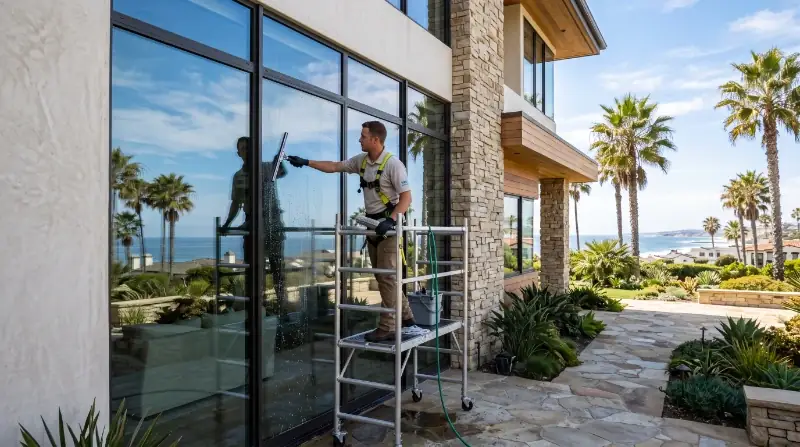
Deionized water-fed pole
Slider door — ocean view
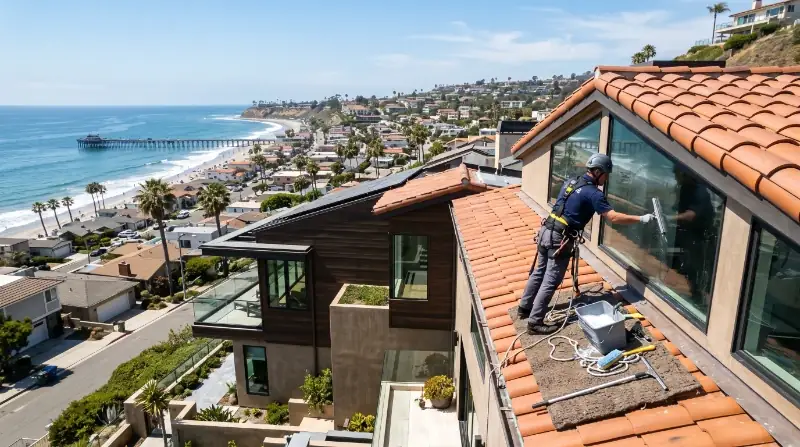
Ocean view — luxury home
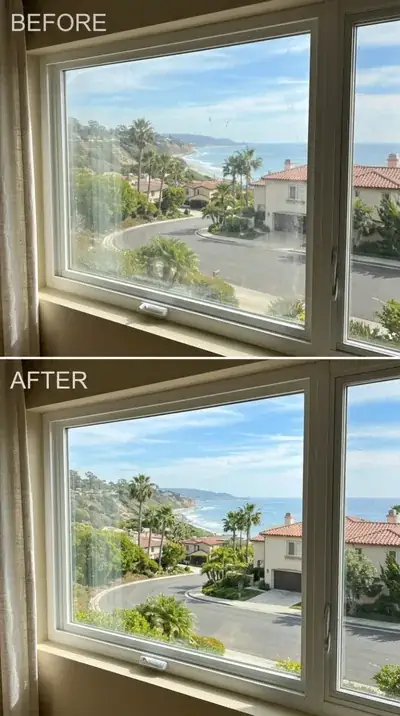
San Clemente, CA
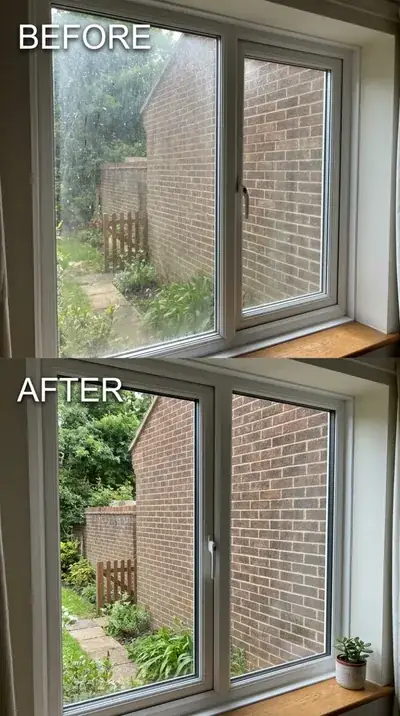
Talega — hard water
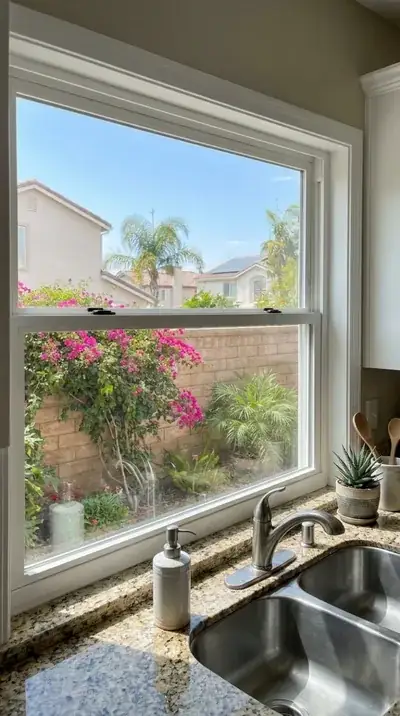
Newport Beach, OC
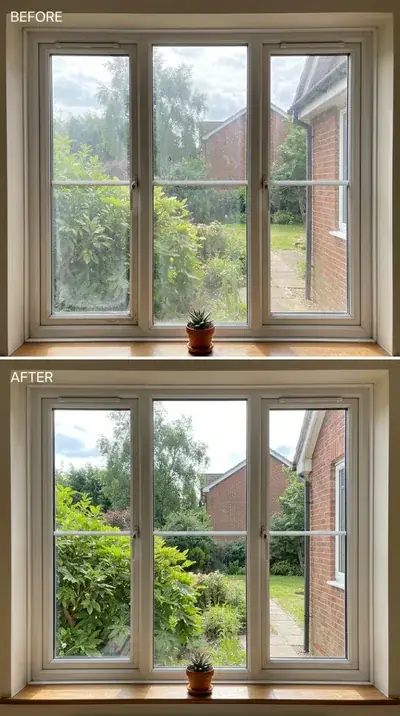
San Clemente — result
3 Typical San Clemente Window Washing Jobs
These are three common job types, shown with the price ranges from our standard price list. They are examples to help you picture your own quote, not records of specific customers.
Why Advice That Works in Irvine Won't Work in San Clemente
Most window cleaning services in Orange County are calibrated for inland dust and pollen. San Clemente is a different environment. These are the specific ways generic advice fails here.
"Clean with tap water and squeegee"
Works inland. Fails here.
The City of San Clemente's 2025 water quality report puts city water at 14 to 17 grains per gallon. Rinse with it and those minerals dry right back onto the pane, so you add deposits while removing grime. A 0 TDS deionized rinse is what leaves the glass clean.
"Once a year is enough"
Works in drier climates. Fails here.
A yearly wash can work in a dry inland city. Beachfront glass in San Clemente shows salt film within days of a professional clean, and salt or mineral film left on for many months can start to etch the surface. Once a year leaves too long a gap on the coast.
"Vinegar removes hard water spots"
Partially true. Fails on coastal deposits.
Vinegar is a mild acid that dissolves fresh calcium carbonate, one part of a sprinkler spot. It does nothing to the silica that comes with it. Spots on San Clemente glass are usually a mix of both, and the silica part needs a professional treatment.
"Brush screens in place to save time"
Acceptable inland. Wrong here.
Screens on a coastal home carry concentrated salt in the mesh. Brushing in place pushes salt deeper into the mesh and redistributes it to the glass every time the window is opened. That is why screens come off the frame, get washed flat and go back in on every visit.
"Clean any time — weather doesn't matter"
True inland. Critically false after Santa Anas.
After a Santa Ana wind event, aim to rinse within 72 hours. Dust and ash blown in from the canyons start to cake on once coastal moisture returns, and the longer they sit the harder they are to remove. Inland, timing barely matters; here it does.
"Hard water spots — just clean them off"
Works on fresh deposits. Wrong on established ones.
A season or two of irrigation overspray leaves bonded mineral deposits that a standard wash cannot remove, so they need a mineral-dissolving treatment. Keeping them from coming back means finding and redirecting the sprinkler head behind them.
Is it worth it to get windows professionally cleaned?
In San Clemente, usually yes. Salt and mineral film left on beachfront glass for many months can etch it, and an etched pane has to be replaced, which costs far more than a wash. A professional clean runs $200 to $350 for a single-story home and $300 to $500 for a two-story, with screens, tracks and sills included. Spray cleaner and paper towels on salt-filmed glass can leave fine scratches, so DIY often speeds up the damage it is meant to prevent. Clean glass also brings the natural light back and adds easy curb appeal if you plan to sell.
How often should house windows be washed?
Most house windows here need a wash somewhere between every six weeks and every three months, depending on salt exposure. Pier Bowl and Linda Lane homes sit in the heaviest salt and usually book every six to eight weeks in summer. Homes on the T-Street side of town get a bit more breathing room, about eight to ten weeks. Talega and Forster Ranch see more sprinkler spotting than salt and usually book quarterly, and any home in town should be rinsed within 72 hours of a Santa Ana wind event. Our San Clemente window washing frequency guide has the full schedule.
Do window cleaners clean inside and out?
Yes, and on a coastal home it helps to know which side is causing the problem. On San Clemente homes, the outside of the glass collects nearly all of the salt air, marine layer film, sprinkler spots and Santa Ana ash. The inside of a sealed double-pane window never sees any of it. When you book a full clean with Clarity Coast, every visit covers both exterior and interior glass, plus screen removal and washing, track clearing, and sill cleaning. Interior cleaning removes household dust, fingerprints, and residue from interior condensation. Exterior cleaning is where the coastal-specific chemistry work happens.
How do professionals wash windows?
Clarity Coast pros use a water-fed pole system with deionized water purified to zero total dissolved solids, or 0 TDS. That means the water itself has no minerals to leave behind when it dries. The system uses soft-bristle brush agitation on the glass surface, then a final deionized-water rinse that air-dries streak-free. Before any glass work, tracks and sills are cleared dry to prevent salt grit re-deposition during cleaning. Screens come off the frame, get washed flat and go back on, instead of being brushed in place, which pushes salt through the mesh onto clean glass. Squeegees stay off heavily salt-filmed outside glass, because a blade dragged over bonded salt can scratch it. The right method here is not the same as the right method in Irvine.
Get Your Free San Clemente Window Washing Quote
Tell us your neighborhood and number of stories. We'll give you a specific price range before you schedule, with no in-person visit required for most San Clemente homes.
Monday–Saturday 8am–6pm · No sales pressure · Price confirmed before scheduling