Hard Water Damage on Windows in Orange County
Spots, then scale, then etching
Hard water damage on windows in Orange County starts as faint white spots and can end as permanent etching. This guide shows why, district by district.
Why is Orange County water so hard on windows?
Orange County water is hard because most of it is imported from the Colorado River and Northern California, and both sources collect calcium and magnesium along the way. Nearly every south county supply with a published figure averaged above the USGS very hard line of 180 mg/L in its latest report. The exception is Moulton Niguel Water District's Diemer-treated water, at 9.3 grains per gallon in its 2023 report.
The Metropolitan Water District of Southern California, or MWD, is the wholesaler behind most of it. MWD brings in Colorado River water and State Water Project water from the north, treats it, and sells it to local districts. Two treatment plants matter most for south county glass. MWD's Diemer plant supplies districts including Moulton Niguel. IRWD's Baker Water Treatment Plant treats MWD water together with water from Santiago Reservoir, also called Irvine Lake, and its output comes out harder.
Local groundwater is the third source, and it's the only soft one. Santa Margarita Water District pumps eight wells in the San Juan Basin and treats the water with sand separators, green sand filters, cartridge filters and reverse osmosis. Per SMWD's 2026 report, the plant's RO-treated output is about 0.17 grains per gallon. That water is blended with imported supply for San Juan Capistrano, so hardness there rises and falls as the blend shifts.
How hardness is measured
Water reports list hardness in milligrams per liter (mg/L) or grains per gallon (gpg). One grain per gallon equals 17.1 mg/L, and the USGS scale calls anything above 180 mg/L, or 10.5 gpg, very hard. Total dissolved solids, or TDS, is a broader figure that counts everything dissolved in the water, including sodium and silica. TDS is the better guide to how much residue a drying droplet leaves on glass.
How hard is the water in each South Orange County district?
Average hardness across south Orange County's published systems runs from 9.3 to 17.3 grains per gallon, depending on the district and the treatment plant. The table below uses only figures from each provider's own water quality report. Where a report didn't give a value, the cell shows a dash.
| Water system and report | Average hardness | Reported range | Average TDS | Main source |
|---|---|---|---|---|
| SMWD, San Juan Capistrano system (2026 report, 2025 data) | 210 mg/L (12 gpg) | 89–290 mg/L (5.2–17 gpg) | 503 ppm | San Juan Basin groundwater treated by RO, blended with imported MWD and IRWD water |
| SMWD main system, including Talega (2026 report, 2025 data) | 256 mg/L (15 gpg) | 210–300 mg/L (12.3–17.5 gpg) | 614 ppm | Imported MWD water and IRWD Baker plant water; no groundwater |
| City of San Clemente, MWD treated water (2025 report) | 236 mg/L (14 gpg) | 11–16 gpg | 545 ppm | MWD imported water; City groundwater plant offline in 2025 |
| City of San Clemente, IRWD Baker plant water (2025 report) | 293 mg/L (17 gpg) | 16–19 gpg | 625 ppm | MWD water plus Santiago Reservoir |
| Moulton Niguel WD, Diemer plant water (2023 report) | 9.3 gpg | 5.7–12.8 gpg | — | MWD imported water |
| Moulton Niguel WD, Baker plant water (2023 report) | 17.3 gpg | 16.45–18.7 gpg | — | MWD water plus Santiago Reservoir |
Three patterns stand out, and they explain most hard water damage on windows in Orange County. Baker plant water is the hardest entry in both the City of San Clemente's report and Moulton Niguel's. SMWD's San Juan Capistrano system has the widest swing, because the share of soft RO groundwater in the blend changes through the year. And even the low ends of most ranges are hard enough to spot glass, so a softer month buys you very little.
Moulton Niguel's own narrative gave a 2023 average of 13.3 gpg, which sits between its two plant figures. SMWD's San Juan Capistrano report also lists sodium at 84 ppm, against 95 ppm in its main system.
What about Dana Point?
Most of Dana Point, including Capistrano Beach and the Lantern District, is served by South Coast Water District, and Moulton Niguel lists Dana Point among the six cities it serves. We couldn't verify a published South Coast hardness figure, so it isn't in the table. Both districts rely mainly on imported MWD water, so Dana Point's tap water typically lands in roughly the 9 to 17 gpg band that neighboring districts report.
One future change is worth watching. South Coast Water District won Coastal Commission approval for its Doheny Desalination Plant in October 2022, with a planned capacity of 5 MGD that could later grow to 15 MGD. Once it runs, it could change the local mix. Until then, assume imported-water hardness.
What do hard water stains on windows look like at each stage?
Hard water stains on windows pass through three stages: loose spotting, bonded scale, and etching. Spotting washes off, scale needs a treatment, and etching is damage to the glass itself that can be reduced but not erased. Which stage you're at depends mostly on how long the minerals have been there and how often they were rewetted.
Stage 1: Spotting
White dots or rings, usually in a pattern that matches a spray. The minerals sit on top of the glass. Calcium carbonate at this stage dissolves in a mild acid such as vinegar, and a thorough wash with a pure water rinse takes it off. Caught within a few weeks, spotting rarely costs anything beyond a normal clean.
Stage 2: Scale
Repeated wetting and drying stacks the deposits into a cloudy, rough layer you can often feel with a fingertip. Silica builds up alongside the calcium, and vinegar does nothing to silica. Scale needs a professional mineral-removal product, controlled dwell time and a careful rinse. This is the stage behind most of the calls we get.
Stage 3: Etching
Once spots have been left on glass for six months or more, the minerals and repeated moisture can attack the surface. Etched glass looks frosted in patches even straight after a clean. A rough home test: clean the spot, let it dry, then slide a fingertip across it. If it still looks frosted but no deposit is left to feel, the surface itself is probably etched. Treat that as a hint, not a diagnosis.
| Stage | How it looks | How it feels | What removes it |
|---|---|---|---|
| Spotting | Separate white dots or rings | Smooth | Normal wash with a pure water rinse; vinegar for fresh calcium |
| Scale | Cloudy band, often on lower panes | Slightly rough | Professional mineral treatment, then a pure water rinse |
| Etching | Frosted patches that stay after cleaning | Smooth or faintly pitted | Polishing may reduce it; severe cases need new glass |
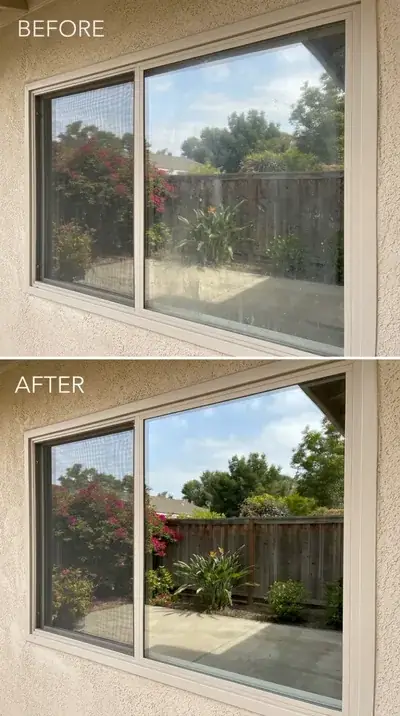
Where does the hard water on your glass come from?
Sprinkler overspray causes most hard water damage on windows in Orange County, well ahead of rain, hoses or cleaning. Irrigation rewets the same panes on a schedule, and every cycle dries into another layer of calcium deposits and silica. Pool splash, hose rinsing and tap-water window cleaning add to the total.
- Irrigation. Spray heads in beds beside the house, rotors on slopes, and heads that lean toward glass as they age. Neighborhoods with large HOA slopes see the most of it, and Talega is a textbook case, covered in our Talega hard water windows deep-dive.
- Pool and spa splash. Splash and wind-blown spray from pools and spa jets land on sliders and lower windows facing the yard. Inland estates with pools see a lot of this.
- Hose rinsing. Washing down patio furniture or the windows themselves with a hose puts tap water straight on the glass, where it dries into the same deposits a sprinkler leaves.
- Tap-water window cleaning. Any method that finishes with a tap-water rinse and lets it air dry leaves a thin mineral film.
- Salt air and sea spray. Glass inside roughly two miles of the breaking waves picks up salt film much faster than glass farther back. Salt and mineral spotting together build up faster than either one alone, and the May to July marine layer can refresh that film overnight, leaving a coastal haze on the glass by morning.
Where you live changes the mix. Coastal glass in Dana Point fights salt and spotting at once, the main theme of our page on hard water stain removal in Dana Point. San Juan Capistrano sits about three miles inland and runs hotter and drier, so overspray dries faster on sun-facing glass and bakes on harder. Our San Juan Capistrano hard water stain removal page covers that inland pattern.
Why sun-facing glass spots worst
Glass that faces south or west heats up through the day. Water that lands on a hot pane evaporates quickly and leaves a tighter, harder deposit than water drying slowly in shade. If only one side of your home is badly spotted, check which way it faces and which heads reach it.
How to prevent hard water spots on windows
The most effective way to prevent hard water spots is to keep irrigation water off the glass, then clean on a schedule that removes new spots before they bond. Coatings and products help at the edges. Moving the water does the real work.
- Find the sources. Walk the property while each irrigation zone runs and mark every head that reaches glass, frames or doors.
- Fix the heads. Lower the arc, shorten the throw, rotate the nozzle away from the house, or move beds along the walls onto drip. If an HOA maintains the head, send a photo of it wetting the window.
- Recheck in wind. A head that misses the glass on a still morning can soak it on a breezy afternoon.
- Keep the hose away from windows. Sweep or blow dust off patios near glass instead of hosing it toward the panes.
- Catch fresh hits early. If a pane gets soaked, a wipe with distilled water and a microfiber cloth before it dries keeps the minerals from setting.
- Match the schedule to your exposure. Oceanfront and bluff-top homes usually need a wash every 6 to 8 weeks, near-coast homes every 8 to 10, and inland homes on a quarterly cycle, about every three months. After a Santa Ana wind event, clean within 72 hours.
- Insist on a pure water rinse. A clean that ends with tap water starts the next round of spots immediately. Ask your cleaner what the TDS meter reads. A proper pure water clean dries streak-free and is eco-friendly as well, with no soap or harsh chemicals running into your beds.
If you do only one thing on this list, fix the sprinkler. Everything else slows spotting down; moving the water stops it.
Why the final rinse matters so much, and what pure water can and can't remove, is covered in how deionized water window cleaning works.
Which removal methods work, and which damage glass?
Vinegar and mild acid cleaners remove fresh calcium spots, professional mineral treatments remove bonded scale, and only polishing or replacement deals with etching. Using the wrong method at the wrong stage either fails or scratches the glass. Identify the stage before you pick the method.
| Method | Works on | Doesn't work on | Risk to glass |
|---|---|---|---|
| Diluted white vinegar | Fresh calcium spots | Silica, bonded scale, etching | Low if rinsed off fully |
| Store-bought hard water removers | Light calcium scale | Heavy silica scale, etching | Low to moderate; some contain abrasives |
| Abrasive pads and scouring powders | Can grind scale off | Etching | High; can haze or scratch glass and coatings |
| Razor scraping | Paint, labels, construction debris | Mineral scale, etching | Moderate to high; scratch risk on some glass |
| Professional mineral treatment with a pure water rinse | Bonded calcium and silica scale | Deep etching | Low when dwell time and rinse are controlled |
| Glass polishing | Light etching | Deep pitting | Moderate; skilled work, can distort if overdone |
| Deionized water alone | Loose film and fresh light spotting | Bonded scale, etching | None |
What a professional treatment involves
A proper treatment starts with assessing each pane, because one side of a house can be at stage 1 while the slider by the pool is at stage 3. The tech tests a small area, applies a mineral-dissolving product suited to the deposit, lets it dwell for a controlled time, agitates it, and rinses with 0-TDS deionized water, usually through a water-fed pole on upper panes, so no fresh minerals are left. Clarity Coast adds this to a regular wash at $150 to $350, and the price is confirmed after the assessment and before any work begins.
Coated, tinted and specialty glass
Many newer windows carry factory coatings or aftermarket film, and abrasives or aggressive scraping can damage those surfaces for good. Tell your cleaner what's on your glass. If you're unsure, ask them to test a corner that nobody looks at first.
When should you replace glass instead of cleaning it?
When hard water damage on windows in Orange County homes reaches deep etching, cleaning stops being the answer. Replace glass when etching is still visible in normal light after a professional treatment, or when repeated treatments start to approach the cost of new panes. A treatment that leaves a pane noticeably clearer is usually worth doing. Stage 2 scale lifted from a south-facing picture window is usually a night and day change, and you notice it first as brighter natural light late in the day. One that leaves it frosted won't improve with a second round.
- Etching that survives treatment. If a treated pane still looks frosted once dry, the surface itself is damaged.
- Fog between the panes. Haze trapped inside an insulated window comes from a failed seal, not hard water. No cleaning reaches it; the unit needs repair or replacement.
- Scratches from past cleaning. Fine scratches from abrasive pads or a dragged blade don't come out with mineral treatment.
- Pane-by-pane decisions. Damage is rarely even across a house. Often only the two or three panes next to a sprinkler need replacing, while the rest clean up well.
Before you replace anything, fix the water source. A new pane installed beside the same misaimed head will start spotting the week it goes in.
What to expect in San Clemente, Dana Point and San Juan Capistrano
Each of the three south county cities sees hard water damage on windows a little differently, depending on who supplies the water and how close the glass sits to the ocean.
San Clemente
Most of the city buys from the City of San Clemente, whose 2025 report showed 14 gpg for MWD treated water and 17 gpg for Baker plant water. Talega is the exception, on SMWD's main system at an average of 15 gpg. Coastal neighborhoods add salt film to the spotting, while inland tracts with big HOA slopes deal mostly with sprinklers. Our San Clemente hard water stain removal service handles both.
Dana Point
Ocean-view glass, terraced lots with irrigation stepping down the hill, and steady salt exposure make Dana Point a salt-plus-mineral problem. Water comes mainly from imported MWD supply through South Coast and Moulton Niguel. Expect stage 2 scale to form sooner on bluff-top homes than on comparable homes inland. On a bluff-top home where the glass frames a million dollar view, even a light band of scale shows the moment the sun drops toward the water.
San Juan Capistrano
SMWD's San Juan Capistrano system swings between 5.2 and 17 gpg as the groundwater share changes, so spotting can look noticeably worse in some months. Inland heat dries overspray fast on sun-facing glass, and pool splash on estate lots adds another source. There's less salt, but more dust and pollen. Spotting on street-facing panes also chips away at curb appeal on these inland homes, so the front of the house is a sensible place to start.
If you're not sure what stage your windows have reached, a pro can usually tell within a few minutes on site. Clarity Coast is licensed and insured in California and connects homeowners in all three cities with vetted local window pros who assess hard water on every visit. A full-service visit covers glass inside and out plus screens, tracks and sills, which is where spotting along a slider's lower edge tends to hide.
More Questions About Hard Water Damage in Orange County
Does rain cause hard water spots on windows?
Rain carries very few dissolved minerals, so on its own it rarely causes true hard water spots. When it mixes with dust, salt or pollen already on the glass, it can leave dirty water marks, but those wash off easily. The stubborn white spots almost always come from tap or irrigation water.
Will a water softener prevent hard water damage on my windows?
Usually not on exterior glass, because irrigation lines typically bypass a whole-house softener. Softening also replaces calcium with sodium rather than removing dissolved solids. Keeping sprinklers off the glass and using a pure water rinse do far more.
Can hard water etching be repaired?
Light etching can sometimes be reduced with professional glass polishing, but results depend on how deep it goes. Deep etching can't be fully reversed. That's why removing spots before they reach the six-month mark matters so much.
How do I find out who supplies my water in Orange County?
Look at the name on your water bill. Each district publishes an annual water quality report, often called a Consumer Confidence Report, listing hardness and TDS. Talega residents, for example, should read the Santa Margarita Water District report rather than the City of San Clemente's.
Do new windows resist hard water better than old ones?
Newer glass may carry coatings that shed water a little more easily, but no window glass is immune to mineral deposits. A new pane next to a misaimed sprinkler spots just as quickly as an old one. Coatings also need gentler cleaning, so tell your cleaner what you have.
Find Out What Stage Your Glass Is At
Call (949) 883-1300, Monday to Saturday 8am to 6pm. Hard water is assessed on every visit, and any treatment is priced before work begins.